

DevIQ enjoyed attending the annual AWS re:Invent conference (something we have been doing for years) in Las Vegas in December 2025. This premier cloud computing event brought together the global cloud computing community for a week of keynotes, technical sessions, product launches, and networking opportunities.

For DevIQ, the conference continues to be critical for deep technical learning, partner alignment, and business development.
AWS re:Invent 2025 made one thing clear: we’ve moved beyond “experimenting with AI.” Enterprises are now entering an agentic era, where AI systems actively orchestrate work across data, applications, and infrastructure.
This shift isn’t about adopting another tool – it’s about rethinking how software systems are designed, how teams operate, and how value is created. Below are the key themes that matter most for business and technology leaders.
1. Agentic AI is a New Operating Model – not a Feature
AI agents are no longer passive assistants responding to prompts. They are becoming autonomous participants in systems: observing, deciding and acting continuously.
This marks a shift from:
- AI as “copilot” to AI as orchestrator of workflows, data, and decisions
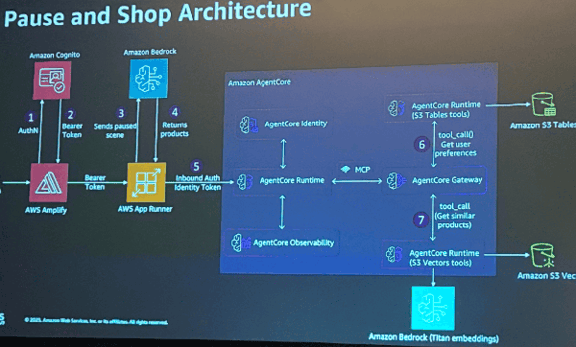
- Agentic AI, AgentCore, and MCP integration as the future of software development
For organizations, this means competitive advantage will come from how well agents are designed, governed, and integrated, not simply which model is used.

2. The Rise of AI Orchestration Platforms
AWS introduced major advances that make agentic systems enterprise-ready:
- Native support for multi-step, long-running AI workflows
- Built-in identity, observability, policy enforcement, and memory
- Strong focus on multi-tenant and SaaS-ready architectures
The takeaway: AI is moving out of prototypes and into production-grade platforms, where scalability, security, and cost control are first-class concerns.
3. MCP: The “API Layer” for the AI Era
One of the most important but least flashy developments is the rapid adoption of Model Context Protocol (MCP).
MCP acts as a standardized interface that allows AI agents to:
- Safely access APIs, tools, and data
- Interact with legacy systems
- Operate across cloud and vendor boundaries
Why this matters:
- MCP is becoming the connective tissue between AI and enterprise systems
- It dramatically reduces the friction of integrating AI into existing environments
- It enables faster modernization without full rewrites
In short: MCP is how AI meets the real world.
4. Data is Still the Deciding Factor
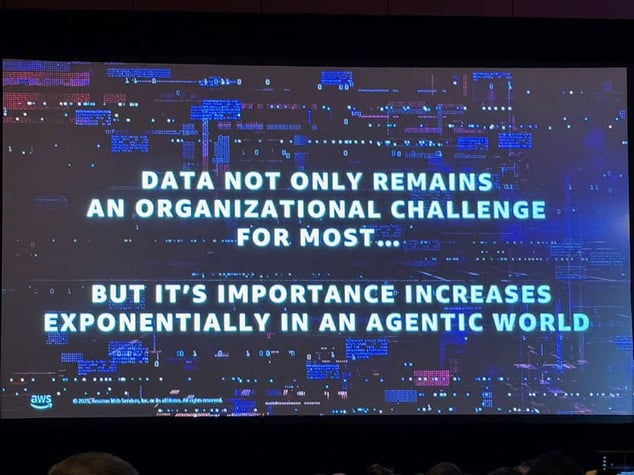
Despite all the AI momentum, re:Invent reinforced a familiar truth:
Data quality, structure, and accessibility determine AI success.
Key signals:
- Data engineering was repeatedly cited as the most critical AI role
- Vector search and similarity search are becoming standard
- Core storage platforms are being redesigned to support AI-native access patterns
Organizations that haven’t modernized their data foundations will struggle to unlock real AI value regardless of how advanced the models become.
5. Memory is What Separates “Smart” from “Useful”
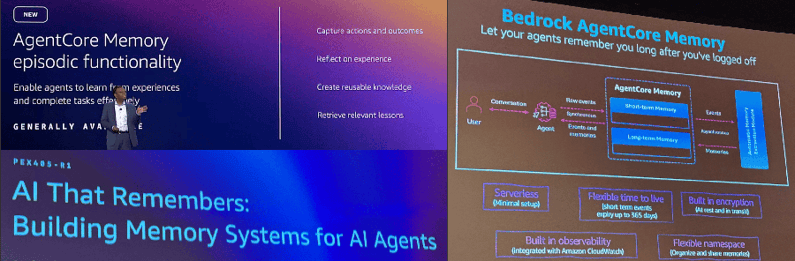
One of the clearest themes was the importance of AI memory.
Effective agentic systems require multiple memory types:
- Short-term conversational context
- Long-term knowledge and facts
- Procedural memory (how work gets done)
- User and tenant-specific understanding
Without memory, agents are reactive and shallow.
With memory, they become context-aware, adaptive, and genuinely valuable.
This is especially critical for enterprise and SaaS platforms serving multiple customers.
6. From Builders to Orchestrators
A broader shift is underway in how teams create software:
- Less emphasis on writing individual lines of code
- More focus on designing systems, workflows, and interactions
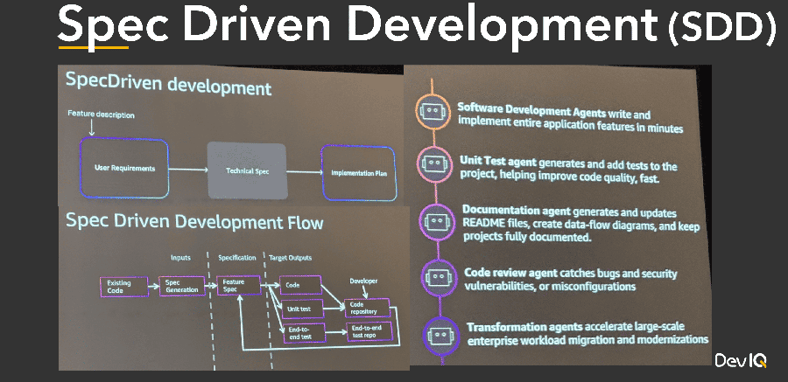
- AI handles execution; humans provide structure, intent, and governance
- Spec-driven development (SDD)
This transition favors organizations that think in systems, not silos and design for scale from day one.
7. A “Renaissance” Moment for Technology Leaders
Werner Vogels (VP & CTO of Amazon) gave his last AWS Keynote and framed the current moment as a modern renaissance – one that rewards:
- Curiosity
- Systems thinking
- Cross-disciplinary fluency
- Ownership and adaptability
The most successful teams won’t just adopt AI tools – they’ll redefine how work gets done using them.
Read more thoughts from this keynote in this LinkedIn post by Shawn Davison, Co-founder and CTO of DevIQ.

What this Means for Enterprises
The winners in this next phase of AI will be organizations that:
- Treat AI as a platform capability, not a point solution
- Invest in data, memory, and orchestration – not just models
- Design agentic systems that are secure, scalable, and multi-tenant
- Use standards like MCP to modernize without disruption
- Build teams and architectures optimized for continuous change
AI is no longer just accelerating development – it’s reshaping how systems think, act, and evolve.