

From JEPA and world models to physical AI, decision models, and neuro-symbolic intelligence, new AI capabilities are emerging alongside frontier LLMs. The question for executives: are we watching closely enough – and preparing to use them?
For the past several years, the AI conversation has been dominated by large language models. ChatGPT arrived, generative AI exploded, and suddenly every major technology company was racing to build a better foundation model. And what a race it has been.
But something fascinating is happening beneath the headlines. An entirely new landscape of AI capabilities is coming into view. Models that make decisions, predict future conditions, represent physical environments, and reason about relationships. Some use fundamentally different architectures; others put familiar techniques to work on different problems. These aren't just new versions of ChatGPT.
Here's what has me thinking: while we watch the next GPT, Claude, or Gemini release, what other model breakthroughs might we miss? And what should enterprise leaders be doing now to recognize where these capabilities could change their businesses?
I think we're witnessing another major turning point in AI. And I'm not sure the enterprise market fully appreciates what's coming.
The Expanding AI Landscape
One distinction helps make sense of all this. Three things can change: architecture (how a model processes information, whether transformer, diffusion, or another design); representation (how text, images, video, audio, or sensor data become numerical forms); and learning objective (what the model is trained to predict – another token, a future physical state, an action, or a probability). Many new models still use transformer-like building blocks. The departure isn't necessarily the architecture alone; it's what the model learns and what new business problem that lets us solve.
The Frontier Models Aren't Slowing Down
OpenAI, Google, Anthropic, Meta, and xAI continue pouring enormous resources into advancing general-purpose AI. OpenAI's GPT family and Anthropic's Claude models are becoming increasingly capable at reasoning, software engineering, scientific problem-solving, and autonomous work.
Google recently introduced Gemini 4 Argon, extending its capabilities in reasoning, coding, and multimodal intelligence. Meta has introduced Muse Wonder. Meanwhile, NVIDIA is investing aggressively in physical AI, robotics, and world simulation.
These advances are extraordinary. But making a language model smarter isn't necessarily the same thing as teaching a machine how the world works. Nor does every enterprise decision require an enormous generative model. That's why I'm paying more attention to what else is emerging.
Jev: A Different Approach to Enterprise Decisions
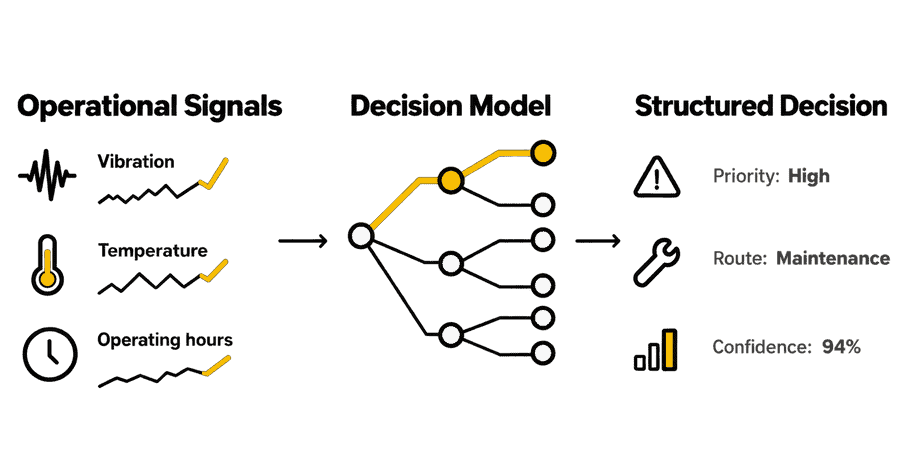
One of the more intriguing recent announcements came from TypeSafe AI, which introduced Jev in September 2026. Jev belongs to what the company calls a new class of System One Models, designed to produce fast, structured decisions rather than generate language.
Think about software that must classify, prioritize, or route thousands of cases. An insurer, for example, needs to identify which new claims deserve specialist review. Jev's approach is to return a structured choice with probabilities that the application can use, rather than generating an explanation that another system must interpret.
The aha moment: the next breakthrough might not be a bigger model. It might be a smaller, faster model that's better suited to a specific decision. Jev is one early example worth watching, not a replacement for LLMs.
JEPA and World Models: Predicting How Environments Change
Another important direction is JEPA, or Joint Embedding Predictive Architecture, closely associated with Yann LeCun. LeCun has argued for years that predicting language alone may not be sufficient to develop intelligence that understands the physical world.
A language model can tell you what happens when a glass falls. But describing that event isn't the same as anticipating how an unfamiliar object will move. JEPA learns an abstract representation of a scene and predicts how that representation changes, rather than trying to recreate every pixel. In plain English, it's learning what matters for prediction, not every detail of what it sees.
Meta demonstrated this direction with V-JEPA 2, which learns from video and supports physical prediction and certain robotic planning tasks. LeCun's subsequent venture, AMI Labs, is pursuing world-model research and applications.
JEPA is one approach within the wider family of world models: models intended to represent an environment and predict how it might change, sometimes in response to an action. Google DeepMind's Genie 4 generates interactive environments; NVIDIA's Cosmos 3 advances physical-world simulation and prediction. Imagine a manufacturer testing a change to a robot's movement before interrupting a production line. The business value is the opportunity to test consequences before taking the risk.
We're early. Predicting a scene is not proof of genuine causal understanding, and these systems are not universal simulators. Still, the move from answering what happened? to exploring what happens if? is potentially enormous.
Physical AI: Intelligence Moves Into the Real World
Closely related is physical AI: systems that bring perception, spatial reasoning, prediction, planning, and control into robotics and autonomous machines. NVIDIA's Cosmos and GR00T initiatives, along with Google's Gemini Robotics 2, illustrate this direction.
Here's the distinction: a world model might help predict what happens if a robot changes its grip. Physical AI helps the robot see the part, choose a movement, and make that grip. One helps anticipate; the other connects intelligence to action. They can work together, but neither is simply another LLM architecture.
The implications extend beyond robots to manufacturing, transportation, logistics, industrial automation, and infrastructure. We've had engineering simulations, control systems, and digital twins for decades. What's changing is the potential for AI to learn aspects of complex system behavior from data and use that understanding to support more adaptive decisions.
Neuro-Symbolic AI: Bringing Knowledge, Relationships, and Logic Together
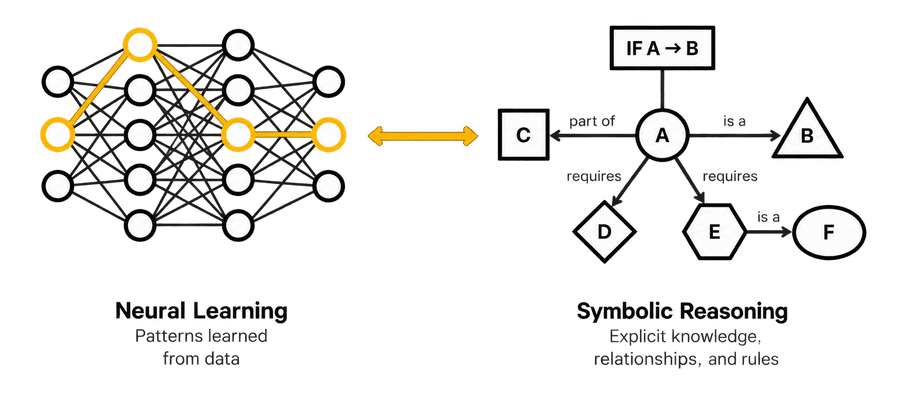
Neuro-symbolic AI is another architectural approach deserving attention. Researchers have explored it for years, but advances in foundation models are making the combination increasingly interesting. It brings together neural networks, which learn patterns, with symbolic representations of knowledge, relationships, rules, and logic. Think ontologies, knowledge graphs, constraints, and reasoning engines working alongside learned AI models.
Consider construction. A predictive model might flag a likely materials delay; a knowledge graph and scheduling rules could determine which downstream activities that delay affects. Instead of just predicting a problem, the system can reason over the dependencies that turn it into a business impact.
The opportunity is to combine learned intelligence with structured knowledge of how a domain actually operates.
Specialized Models: Fitness for the Problem Matters
Then there's the rise of specialized predictive models. Google's TimesFM-3 forecasts related time series. An operations team could use a model of this kind to anticipate next week's electricity demand or hospital staffing needs. It doesn't need to generate a convincing paragraph; it needs to deliver a useful forecast.
Specialized models are emerging across biology, medicine, scientific computing, geospatial analysis, forecasting, and engineering. Some use transformers and techniques familiar from LLMs; others use different architectures, training objectives, and data representations. Their sizes vary, but fitness for the problem is what matters.
That's the pattern I want executives to notice: models that decide, predict, represent, simulate, or act – often using different data and learning objectives. These categories overlap, and not every announcement is a fundamentally new architecture. But taken together, they are expanding AI well beyond language generation.
Why So Many Model Types Now?
Three forces are converging. Compute and much richer data – video, sensors, and simulations – make it possible to train beyond text. New representations and training methods make that data more useful. And enterprises increasingly want models suited to specific decisions and outcomes, not just better general-purpose answers. The investment tells its own story: Yann LeCun's AMI Labs raised $1.03 billion to pursue world models; TypeSafe AI raised roughly $870 million after launching Jev; and NVIDIA launched its Cosmos Coalition to advance open world models for physical AI. Funding isn't proof of results, of course. But it's a strong signal of where people are placing bets – and why I expect more new model types to emerge.
Why Executives Need a Broader AI Radar
This is the part I don't want lost in the technical discussion. We've trained ourselves to follow new GPT, Claude, and Gemini releases. We now need to watch new model categories and capabilities, too. Ask three questions when one appears: What can it do that was difficult or uneconomical before? Is there credible evidence that it works? Which decision in our business could it improve?
Industry-Specific Intelligence
In financial services, specialized models could analyze transaction patterns, financial relationships, market behavior, and risk exposure, combining prediction with decision models and regulatory constraints. In insurance, related capabilities could support underwriting, claims processing, fraud detection, and risk assessment.
In manufacturing, physical and predictive models could help anticipate equipment failures, evaluate operational alternatives, and optimize production environments. In construction, systems could connect schedules, resources, costs, materials, subcontractor dependencies, and project history to help anticipate delays or cost overruns.
In healthcare and life sciences, specialized models could work across medical images, clinical data, molecular structures, and biological relationships to support research and better-informed clinical decisions. These are opportunities to evaluate against domain requirements, rather than evidence that every emerging approach is ready for production.
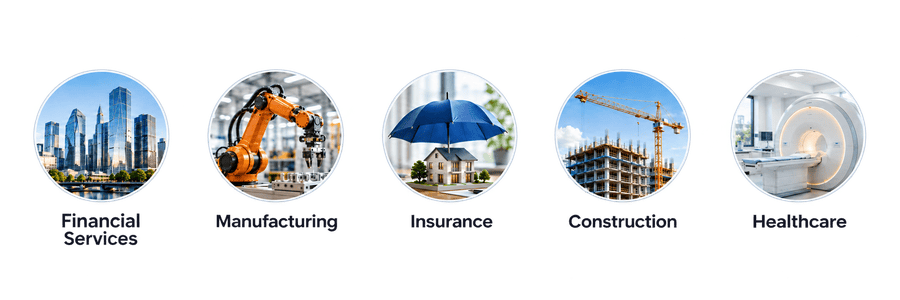
Why should one general-purpose model be equally good at underwriting risk, forecasting an equipment failure, analyzing a medical image, and optimizing a construction schedule? I expect industry-specific models to become increasingly important – and for the best enterprise systems to combine them with general-purpose models rather than choose one or the other.
The Last Great Enterprise Moat?
Now take this one step further. As powerful foundation models become more widely available, enterprises will increasingly have access to similar underlying technology. But they also possess decades of proprietary data, operating history, customer behavior, specialized processes, and institutional knowledge. Much of that knowledge has never been captured in a way that AI can readily use.
What if enterprises could transform that accumulated knowledge into proprietary intelligence?
I'm talking about purpose-built systems that extend beyond a chatbot or document-retrieval application, combining multiple model types, structured domain knowledge, predictive capabilities, and proprietary operational data.
An LLM might provide language understanding and reasoning, while a decision model classifies or evaluates options. Specialized predictive models could forecast outcomes, and world models or simulation engines could help explore possible future conditions. Ontologies and knowledge graphs could establish relationships and meaning, with rules and governance constraining actions and decisions. Some models could also be trained or adapted using data unique to the enterprise.
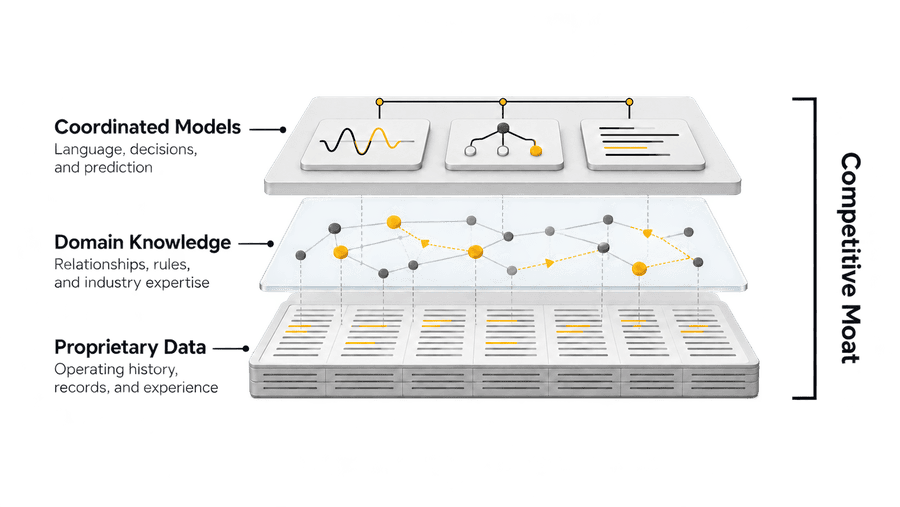
The result doesn't have to be one enormous custom model. The most effective enterprise intelligence may be a coordinated system of several models, connected through a shared understanding of the business. The right combination will depend on the problem, rather than a requirement to include every model type.
Of course, having proprietary data isn't enough. It must be accessible, trustworthy, connected, and understood, and the resulting system must be continuously evaluated against real business outcomes. That's a readiness agenda for executives today: connect data to the decisions it informs, define how results will be measured, and make it possible to test new models as they emerge.
That could create a durable competitive advantage. Competitors may be able to buy the same AI technology, but they cannot easily reproduce the history, expertise, and proprietary knowledge that make the system valuable.
We May Be at Another AI Inflection Point
The arrival of foundation language models changed the technology industry by making general-purpose intelligence broadly accessible. I increasingly think that was only the first chapter. We're now seeing intelligence diversify: models that generate, decide, predict, simulate, reason over relationships, and act in the real world.
Some of today's emerging architectures will be overhyped. Others will become foundational technologies, and we don't yet know which will dominate. That's why executives need a wider technology radar: not just the next frontier LLM release, but new model categories, independent evidence of what they do, and the business problems they might finally make practical to solve.
For technology and business leaders, the next step isn't necessarily to build a custom model. Start by broadening what you watch, identifying a few consequential business decisions, and preparing the data and measures needed to evaluate new capabilities. We've spent the past few years asking which LLM to use. We should also be asking what other kinds of intelligence are becoming available – and where they could change our economics or competitive position.
What intelligence could we build, using our industry's knowledge and our enterprise's proprietary data, that nobody else can easily replicate?
That's a much bigger question than which LLM to deploy – and potentially a turning point as significant as the arrival of foundation language models.
The first wave of AI learned to speak our language. The next wave may learn how our businesses, and the world around them, actually work.