

Part 1 of this series compared isolation architectures: dedicated catalogs, dedicated workspaces, and strong logical isolation. Part 2 moved from architecture choice to execution and positioned tenant-scoped Genie spaces as a core AI boundary.
In this final article, we close the loop on the external edge: how to integrate AI agents through MCP without breaking tenant isolation.
Why MCP Changes the Risk Profile
MCP unlocks powerful tool-calling and automation, but it also amplifies mistakes – so tenant context must survive from first authentication to final tool invocation, with enforcement that aligns to both Genie and Unity Catalog.
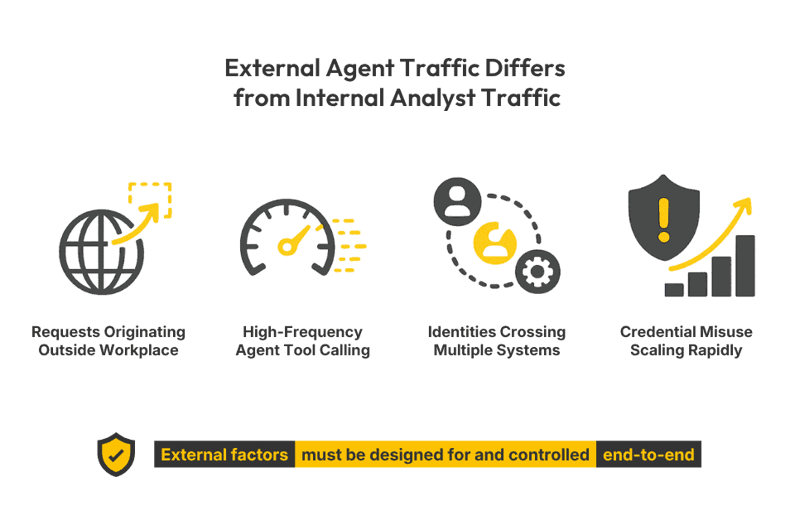
External agent traffic differs from internal analyst traffic:
- requests originate outside your workspace boundary
- agents may execute high-frequency tool calls
- identity is often translated across multiple systems
- credential misuse can scale rapidly
The architecture must preserve tenant context from first authentication event to final tool invocation.
Designing the Tenant Boundary at the MCP Edge
In Part 2, the safe pattern was one Genie space per tenant – provisioned from a standard template and bound only to tenant-approved data resources and tools. MCP integration must preserve that same boundary when requests originate outside the workspace.
The invariant is simple: an external request must resolve canonical tenant context before it reaches Genie, tools, or data – and it must remain constrained by Unity Catalog policies throughout execution. If tenant context is inferred downstream, or if credentials and routing decisions are shared across tenants, the Genie boundary becomes a shared risk surface again.
The Tenant-Safe MCP Control Stack
A strong pattern for external integration has four controls:
- Identity-first tenant resolution
- Tenant-scoped credentials
- Policy-validated request routing
- Full audit lineage
The guiding principle is simple: external agents should operate with no more privilege than a tenant-scoped user in the same context.
End-to-End Request Flow (Tenant-Preserving)
- External app/agent authenticates and presents OIDC-backed identity context.
- MCP entry layer validates token integrity and tenant claims.
- Request is evaluated against tenant and tool policy.
- Tenant-specific credential reference is resolved from the edge control plane (backed by KMS/secret management).
- Request is routed to the correct tenant Genie space and tenant-bounded Unity Catalog objects (catalog/schema/views depending on the isolation model).
- Response is returned with request, tenant, tool, and policy metadata logged.
This flow preserves tenant boundaries through every hop instead of relying on downstream systems to "figure it out."
Deployment Roadmap
For teams adopting MCP-based external integration, sequence work so identity, secrets, and policy land before scale – and observability ships with the first production path.
- Define tenant claim model and policy schema
- Implement an edge control plane with secret reference patterns
- Add policy enforcement and deny-by-default routing
- Integrate tenant-scoped Genie and Unity Catalog targets
- Add comprehensive observability and negative tests
- Run controlled rollout with tenant-level throttles
Final Takeaway & What's Next
Part 1 helped you choose the right isolation architecture. Part 2 showed how tenant-scoped Genie spaces create an AI boundary aligned to least privilege. In Part 3 we extended that boundary to external agents in a powerful and safe way through MCP.
Teams that operationalize this boundary and preserve tenant context end-to-end – with identity-first routing, tenant-scoped credentials, strict policy enforcement, and full audit lineage – can adopt agentic AI at scale without compromising tenant isolation.