

Much of the conversation around AI in the enterprise still centers on automation – doing the same work faster, cheaper, or with fewer people. That framing is understandable, but it misses the more consequential shift now underway.
What is emerging is not a replacement model, and not an “AI teammate” model. It is something more fundamental: a new relationship between human judgment and machine intelligence that raises the effective intelligence of the enterprise itself.
This relationship can be described as Cognitive Uplift.
Cognitive uplift is not about delegating work to machines. It is about creating a durable equilibrium where AI and humans each do what they are uniquely good at – and where their combination produces outcomes neither could achieve alone.
From Doing Work Faster to Thinking Better
Automation optimizes execution. It assumes the right decision has already been made and focuses on carrying it out efficiently. Cognitive uplift operates earlier and higher in the value chain. It improves how decisions are formed in the first place.
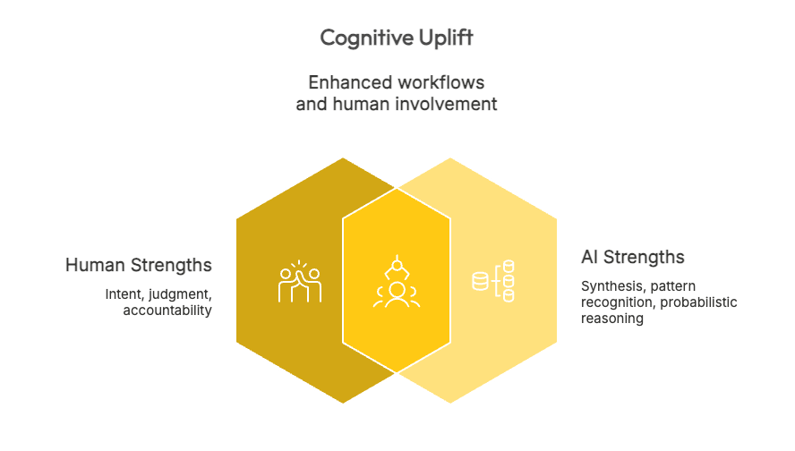
AI excels at synthesis, pattern recognition, recall, probabilistic reasoning, and operating across massive volumes of fragmented information. Humans excel at intent, judgment, values, context, and accountability. Cognitive uplift does not separate these strengths into different lanes. It pairs them deliberately inside real workflows, where decisions are made under pressure and uncertainty.
The result is not less human involvement. It is better human involvement.
The Human-AI Equilibrium
A common mistake is to frame AI as an independent “team member.” That metaphor subtly encourages delegation and parallelism. Cognitive uplift assumes something different: a single decision system composed of two complementary forms of intelligence.
- AI expands the option space; humans constrain, choose, and commit
- AI reduces cognitive load; humans apply meaning and consequence
- AI reasons at scale; humans reason with responsibility
When this balance is achieved, the enterprise operates in equilibrium. When it is lost, AI either becomes over-trusted or underused. But, holding this equilibrium is not automatic – it must be designed.
Intelligence as an Operating Capability
Cognitive uplift is not a feature, tool, or single system. It is an operating capability that cuts across roles, functions, and platforms. It shows up where thinking matters most:
- High ambiguity
- Fragmented information
- Frequent or compounding decisions
- Outcomes that must be learned from, not just executed
AI reshapes the decision environment – surfacing options, highlighting risk, recalling precedent. Humans remain accountable for what is chosen and why.
Cognitive Uplift and the Operating Model
As intelligence moves into workflows, the operating model must evolve. This is already happening. Traditional operating models separate strategy, management, and execution. Intelligence flows upward slowly. Decisions are episodic. Learning lags reality.
Cognitive uplift collapses these gaps. Thinking moves closer to execution. Decisions become more continuous. Operating models shift toward sense-and-respond systems, without abandoning governance or control.
Decision-Centric Operations
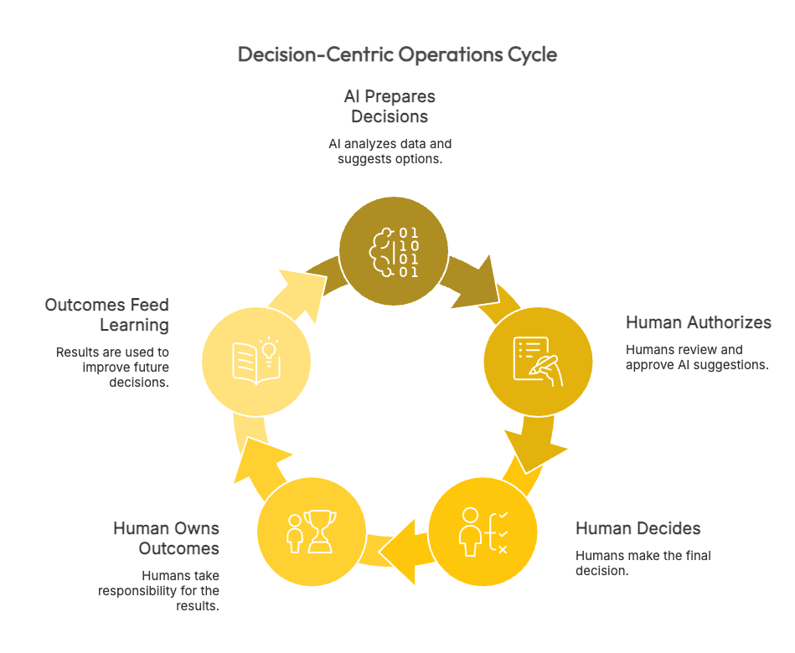
In a cognitively uplifted model, the unit of value is the decision, not the task.
Operating models reorganize around:
- Where decisions occur
- Who owns them
- What intelligence is available at the moment of choice
- How outcomes feed learning
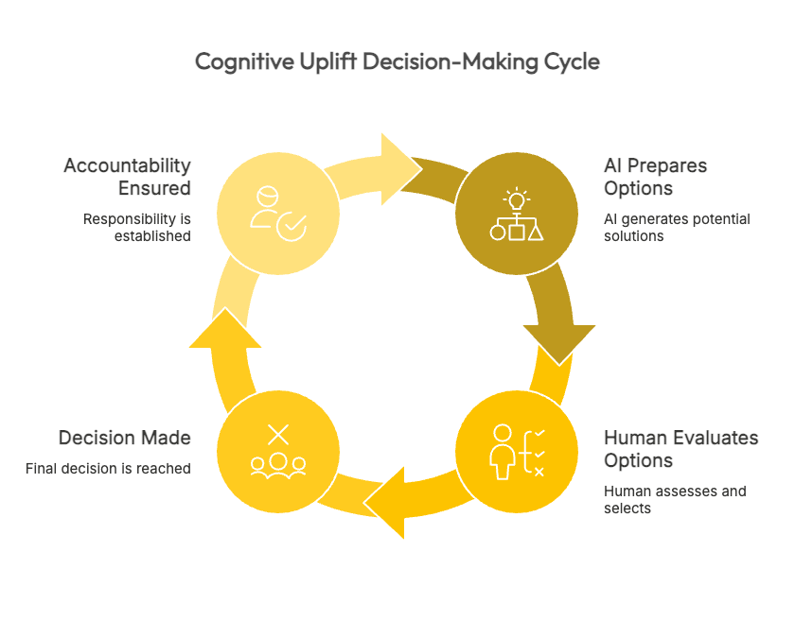
AI prepares decisions before humans engage. Humans authorize, decide, and own outcomes.
Governance Moves Inline
Governance becomes continuous rather than episodic. Policies act as constraints in reasoning systems. Risk thresholds become live signals. Compliance happens at the point of decision. Speed and control increase together.
Learning Compounds
Every meaningful decision produces signal. AI retains context and outcomes, turning daily operations into a living knowledge base. Over time, the enterprise learns faster than its environment changes.
Accountability Does Not Move
A defining characteristic of cognitive uplift is that accountability remains human.
AI can recommend, simulate, and challenge – but it does not own outcomes. This preserves trust, resilience, and judgment, especially in complex or regulated environments.
This is not a limitation. It is a strategic advantage.
The Return of the Generalist
Cognitive uplift changes what kind of human thinking matters most.
For years, enterprises optimized for narrow specialization because information was scarce and fragmented. Expertise lived in individuals and became a bottleneck.
Cognitive uplift reverses this dynamic.
When AI can retrieve detail and synthesize context on demand, breadth becomes more powerful than isolated depth. The most effective employees are those who can connect signals, reason across domains, and apply judgment.
This is a modern generalist – directionally fluent, not shallow:
- Understanding system interactions
- Reasoning across technical, operational, and business dimensions
- Knowing enough depth to ask the right questions
- Using AI to access detail when needed
Specialists still matter. Their role evolves toward shaping constraints, defining intelligence, and guiding reasoning systems. Knowledge compounds instead of fragmenting.
What This Means for Employees
Cognitive uplift changes how work feels. Routine cognitive load – searching, compiling, reconciling – is reduced. Human energy shifts toward:
- Interpretation and judgment
- Exception handling and problem solving
- Learning and improvement
Communication becomes more valuable, but more substantive. Reasoning becomes visible. Learning becomes shared.
Some employees will struggle – not due to lack of AI skill, but because their value was tied to information control or isolated work. Others will thrive: those comfortable with shared thinking, constructive challenge, and probabilistic insight.
This is not deskilling. It is professional elevation.
Two Practical Applications
Product Support in Networked Systems
In network product manufacturing companies, support teams reason across alarms, logs, configurations, firmware versions, topology, and customer environments.
Traditionally, support is optimized for case handling. Patterns emerge late.
Cognitive uplift shifts the focus to decision quality in live operations.
AI synthesizes telemetry, configurations, historical incidents, and remediation outcomes. Before engagement, it prepares probable fault domains, correlated events, diagnostic paths, and early risk indicators.
Humans interpret, decide, and remain accountable. Over time, support becomes proactive and systemic risk is surfaced earlier.
Digital Product Creation in Fashion and Accessories
In fashion and accessories, early decisions – materials, trims, suppliers, cost targets – are often irreversible and made under uncertainty.
Traditionally, feasibility is assessed through spreadsheets and periodic reviews. Issues surface late.
Cognitive uplift embeds intelligence into early design moments.
AI evaluates evolving product definitions against historical BOMs, material availability, supplier performance, design complexity, and prior outcomes. Teams receive ongoing feasibility and risk signals while designs are still fluid.
Designers remain in control. AI prepares the thinking; humans decide. Institutional intelligence compounds without constraining creativity.
From Cognitive Uplift to Agentic Transformation
As decision quality improves, work coordination begins to change. Organizations start delegating bounded action to software – not blind automation, but constrained execution guided by human intent.
This is Agentic Transformation. Agents monitor conditions, carry intent across systems, trigger actions, and adapt execution – while remaining observable, interruptible, and accountable.
Without cognitive uplift, agents are brittle. With it, they become controlled extensions of enterprise intelligence.
The Strategic Choice – and the End State
Enterprises that succeed with AI will not be those that automate the most tasks. They will be those that intentionally increase their intelligence – how well they sense, decide, and learn.
Cognitive uplift is the foundation. Agentic transformation is the progression, and the end state is an Agentic Enterprise: one that reasons continuously, acts deliberately, and adapts at scale – grounded in human judgment and bounded autonomy.
Cognitive uplift is not the destination. It is the transition. The strategic choice is simple: optimize execution – or build an enterprise that can think.