

A 3-Part Thought Leadership Series by Nate Lomax
AI coding assistants are everywhere now. Most developers have experimented with tools that autocomplete code or suggest functions.
But there’s a much bigger opportunity hiding behind those demos:
What happens when AI stops being a sidekick…and becomes an actual teammate?

At DevIQ, we’ve been building Symphony – a production-grade platform that lets AI coding agents autonomously pick up work items, write code, open pull requests, respond to review feedback, and collaborate across real enterprise toolchains.
This series shares what it actually takes to make that real.
Over three articles, we’ll walk through:
- Why “AI in production” is fundamentally different from local experiments
- The architecture decisions behind Symphony
- How we made agents work across Azure DevOps, GitHub, Jira, and more
- What multi-tenant AI orchestration really looks like
- And the lessons we learned building an autonomous engineering platform
If you’re exploring agentic AI beyond demos – this series is for you.
From AI Coding Tools to Autonomous Teammates
Most AI coding tools live on a single developer’s laptop. They help you write a function. They suggest a refactor. They answer a question.
Useful – but limited.
Symphony started with a much more ambitious idea:
What if your AI agent behaved like a real developer on your team?
This is not "AI on the side." It's AI inside the workflow – visible, accountable, and collaborative. Let's look at the typical workflow:

No human needed to kick things off. That simple pitch hides a much harder reality. The challenge isn’t getting an LLM to write code. The challenge is everything else:
- Orchestrating workflows across work tracking and source control
- Managing credentials safely across tenants
- Spinning up isolated environments per job
- Handling review loops
- Supporting multiple platforms and agent types
- Doing all of it at scale without breaking trust or security
This is the problem Symphony was designed to solve.
At its core, Symphony is a multi-tenant orchestration platform that connects your development workflow – work tracking, repositories, and code review – to AI coding agents. Assign a task to the agent user, and Symphony handles the rest.
But we quickly learned that treating agents like teammates requires real engineering discipline.
Two Containers, Not One
Early on, we split the system into two major parts:
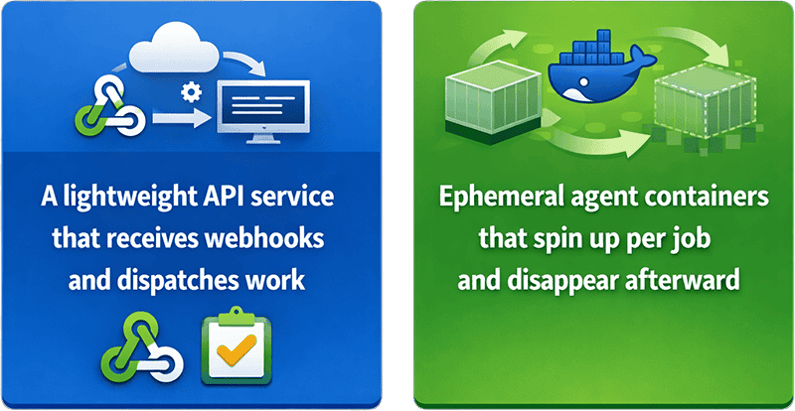
Each coding task gets its own isolated container. This single choice solved multiple problems at once:
- Isolation: One runaway agent can’t affect others
- Scaling: Webhook handling stays fast while agents run heavy workloads
- Security: Each container gets only the credentials it needs
From Webhooks to Working Code
When a work item is assigned or a PR comment appears, Symphony does the following:
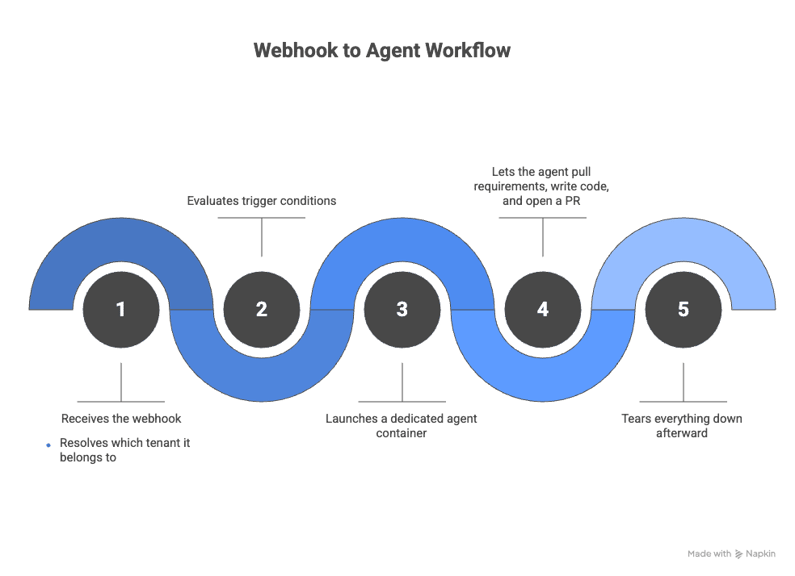
Triggers are declarative – not hardcoded – so teams can change behavior without touching system code. This matters more than it sounds. Because once you have that foundation, you’re no longer building scripts. You’re building a platform.
But orchestration alone isn’t enough.
To truly support multiple platforms, tools, and agents – without rewriting everything each time – we had to rethink architecture entirely.
In Part 2, we’ll dive into the adapter system that makes Symphony flexible, composable, and future-proof.