For the past two years, the AI industry has been fixated on agents. A wave of frameworks promised to transform large language models into autonomous systems that could plan, reason, act, and coordinate work across tools.
The underlying assumption was straightforward: models were powerful, but not yet capable enough to carry the full burden on their own. So we built layers around them.
Planning engines, tool routers, memory stores, and execution loops formed the scaffolding that turned a model into an “agent.”
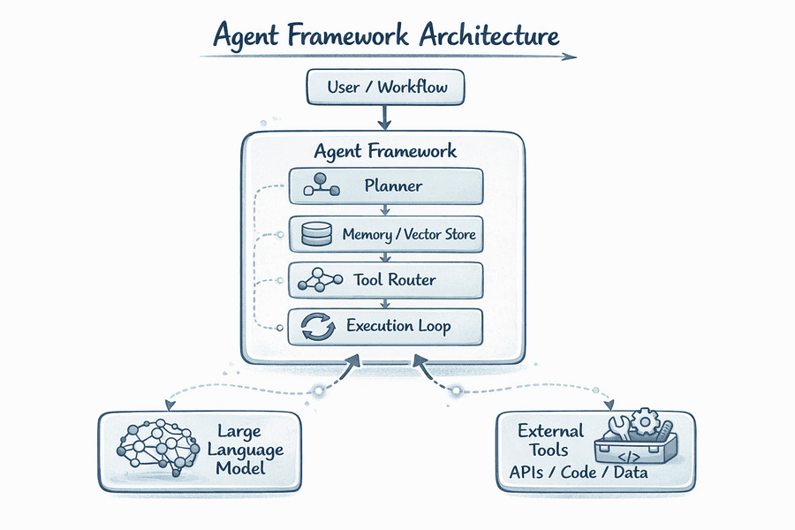
That architecture made sense for the moment. It addressed real limitations in the models and gave builders a way to create systems that felt more capable than the raw model alone. But something important has changed. The newest generation of models is beginning to absorb many of the responsibilities that agent frameworks were created to provide.
Capabilities such as multi-step reasoning, task decomposition, tool selection, execution planning, and navigation through complex environments are increasingly being handled within the model itself. What previously required a stack of orchestration logic outside the model is starting to compress inward. The model is not just generating the next token or the next step. It is taking on more of the runtime behavior that used to define the agent.
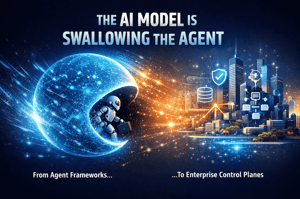
That is why the phrase “the model is swallowing the agent” resonates. It captures a real architectural shift. But the more precise description is this: the agent runtime is collapsing into the model, and in the process, complexity is shifting upward into enterprise coordination layers.
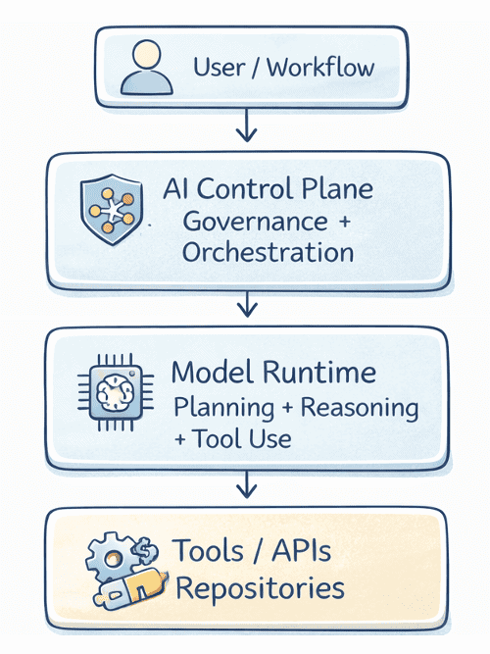
That distinction matters. The implication is not that all agent concepts disappear, or that enterprises no longer need orchestration, governance, or system design. Quite the opposite. What is disappearing is the assumption that the core intelligence has to be spread across a thick middle layer of external frameworks. As models become more capable, that middle layer gets thinner. The reasoning loop, planning logic, and tool-use behavior that once had to be engineered around the model are increasingly moving into the model itself.
Seen this way, agent frameworks were never the final architecture. They were a transitional one. They were necessary because the models needed support. They externalized functions that the model could not yet perform reliably. But as the models improve, the architecture compresses. The wrapper becomes lighter. The center of gravity moves.
What is striking is that the overall complexity does not go away. It simply relocates. As the model absorbs more of the reasoning and execution burden, the hard problems shift upward. The key challenge is no longer just how to make the AI reason through a task. The challenge becomes how to operate AI safely, coherently, and at scale inside real enterprise environments.
Once AI systems start interacting with code repositories, work management systems, internal APIs, enterprise data platforms, and collaboration tools, the problem space changes.
Questions of governance, coordination, permissions, security boundaries, auditability, observability, and organizational memory become central. These are not model problems in the narrow sense. They are systems architecture problems.
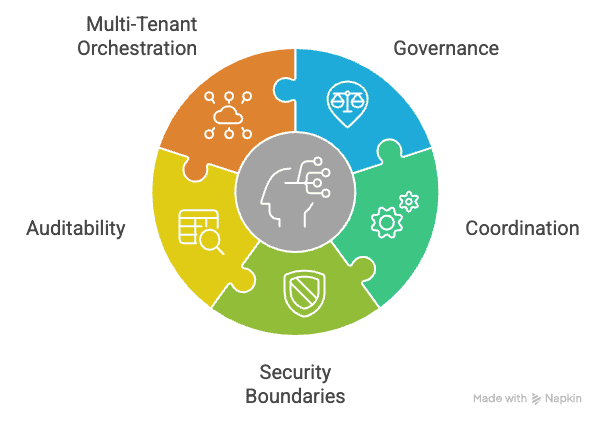
AI control plane responsibilities include:
- Routing work to models
- Coordinating tool ecosystems
- Enforcing governance policies
- Managing agent execution environments
- Capturing organizational memory
- Integrating with enterprise systems
This is where the idea of a control plane becomes useful. If the model is increasingly responsible for the reasoning and action loop, something else must coordinate how that capability is deployed across the enterprise.
It is the layer that determines what the AI is allowed to access, what it is permitted to do, how its actions are monitored, and how its work is coordinated with the rest of the organization.
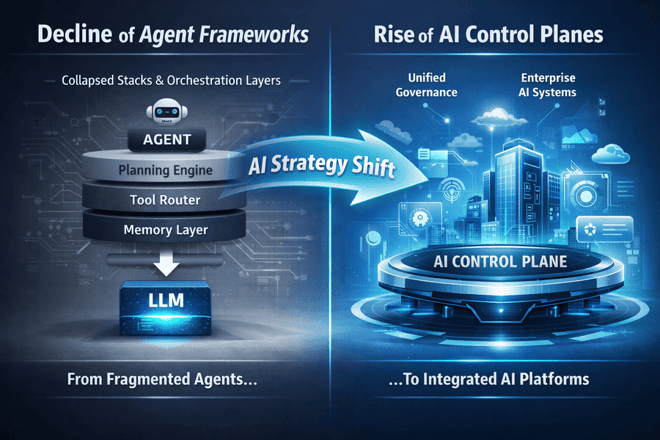
That is why the disappearance of heavy agent frameworks does not make the surrounding architecture less important. It makes it more important. The smarter the model becomes, the more critical it is to have strong coordination and governance around it. As the model takes on more responsibility, enterprises need a clearer way to manage execution, enforce policy, observe outcomes, and integrate AI work into real operating environments.
What This Means for AI Architecture
As models continue to absorb agent capabilities, this control plane layer becomes even more important. The smarter the model becomes, the more critical governance and orchestration become.
For a time, the industry largely assumed the stack would evolve with applications on top, agent frameworks in the middle, and models underneath. But that picture is breaking down. The middle is being squeezed from both directions. From below, models are absorbing more of the agent behavior. From above, enterprise coordination layers are emerging to manage AI work across systems and teams. What remains in the middle is no longer the primary source of value.
That is the larger shift. The architectural emphasis is moving away from building ever more elaborate agent wrappers and toward designing the systems that can coordinate, govern, and integrate increasingly capable models into the enterprise. In that sense, the story is not just that models are getting smarter. It is that the architecture around them is reorganizing.
The most important implication is that the next generation of AI platforms may look less like classic agent frameworks and more like operating systems for AI work. Their job will not be to simulate intelligence that the model lacks. Their job will be to coordinate intelligence that the model already has, and to do so in a way that fits the realities of enterprise execution.
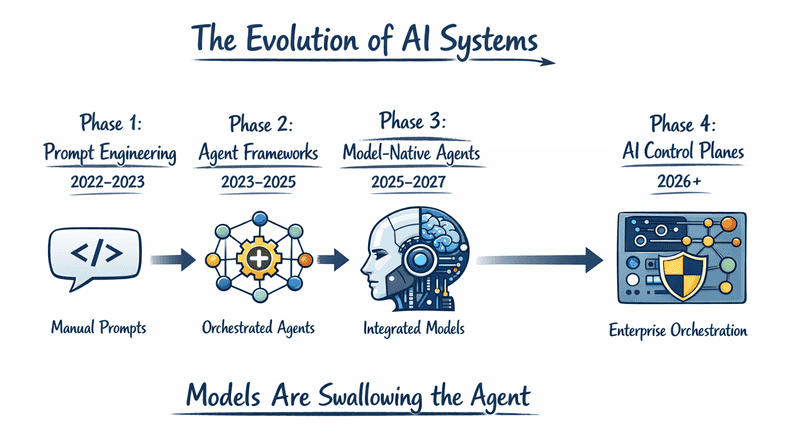
We are now entering Phase 3 and Phase 4 simultaneously. Models are swallowing the agent.
That is why “the model is swallowing the agent” is such a useful hook. It names the compression that is happening. But the deeper point is what comes after. As agent runtime behavior moves into the model, the real engineering challenge moves up the stack. The future advantage will not come only from the model itself. It will come from the systems that coordinate, govern, and operationalize that model inside the enterprise.
That is where the next layer of value is being created.
Final Thought
The most important trend in AI right now is not that models are getting smarter.
It’s that the architecture around them is collapsing.
Planning layers are disappearing.
Tool routers are disappearing.
Execution loops are disappearing.
As those layers collapse, the model absorbs more responsibility.
But the system still needs a way to coordinate, govern, and integrate AI work.
That is the role of the control plane.
And it may become the most important layer in the next generation of AI platforms.