

A Story About the Shift
At 8:17 on a Tuesday evening, a subscriber calls their internet provider.
"The Wi-Fi upstairs keeps dropping. It happens almost every night."
A support technician opens the customer record. The broadband connection looks healthy. The gateway is online. A speed test passes. The troubleshooting application recommends a reboot.
The technician follows the workflow.
The customer calls again the next evening.
This is the limitation of the traditional application paradigm. Applications are built around situations their designers anticipated. They present predefined screens, metrics, reports, and workflows. When the problem fits the model, they work extremely well. When the situation is ambiguous, the human has to bridge the gaps.
The technician may need to inspect the customer account, network telemetry, Wi-Fi controller, device history, support tickets, firmware notes, and product documentation. Each system contains part of the answer. None understands the whole situation.
The applications provide the information.
The human performs the sensemaking.
Now imagine the same call in a different kind of working environment.
The network engineer does not begin by navigating through applications. They begin by describing their intent:
"Help me understand why this subscriber's upstairs Wi-Fi becomes unstable in the evening. Do not make any service-affecting changes without my approval."
An AI agent begins assembling the situation.
It examines the subscriber's service history, broadband connection, gateway and extender topology, connected devices, roaming events, signal levels, retransmissions, channel utilization, firmware versions, prior tickets, and recent configuration changes.
It may bring in other specialist agents. One examines the broadband network. Another analyzes Wi-Fi radio conditions. Another checks known product issues. A fourth challenges the leading explanation and looks for evidence that contradicts it.
Within seconds, the engineer receives something more useful than another dashboard.
The system explains that the broadband connection appears stable. Upstairs signal strength is marginal throughout the day, but service interruptions cluster in the evening when neighboring Wi-Fi activity increases. One older device also remains connected to the downstairs access point longer than it should instead of roaming upstairs.
The engineer follows their intuition.
"Show me the ten minutes before every interruption. Separate the events by device, access point, and roam attempt."
The agent changes the analysis. It creates a timeline and an interactive view specifically for this question. No product team had to design this exact screen in advance.
The new evidence reveals that weak signal alone is not the cause. The interruptions occur when three conditions overlap: marginal upstairs coverage, increased evening congestion, and delayed device roaming.
The agent proposes two reversible changes. It explains the expected benefit, uncertainty, and risk of each.
The engineer approves one.
The agent updates the Wi-Fi configuration, records the change in the support ticket, prepares a plain-language explanation for the subscriber, and monitors the network overnight. The next morning, it compares the results with the previous week.
The interruption rate has fallen.
The agent records what happened, updates the working explanation, and makes the experience available to help resolve similar cases in the future.
Over time, each loop becomes organizational memory: not only what action was taken, but the evidence, reasoning, and outcome that made it appropriate.
That is AI-Augmented Sensemaking.
More Than an Answer
Sensemaking is an established academic term for how people create a workable understanding of an unclear or changing situation so they can decide what to do.
Sensemaking is not a straight line. People gather information, organize it, form explanations, encounter contradictory evidence, revise their understanding, and continue.
It is a loop.
We do this constantly:
- What is happening?
- Which signals matter?
- What might explain them?
- What are we missing?
- What should we do next?
AI did not invent sensemaking. It made it possible to augment the process with extraordinary computational reach.
AI-Augmented Sensemaking is the continuous, collaborative process through which people and AI agents jointly frame a situation, gather and interpret evidence, test explanations, determine what matters, and translate human judgment into governed action.
The agent does not simply answer a question. It helps the person construct and refine an understanding.
That distinction matters.
Reasoning asks, "Given this understanding of the problem, what follows?"
Sensemaking asks, "What problem are we actually facing?"
From Applications to Collaborative Loops
For decades, the application has defined the work.
Developers decide what data appears, which buttons exist, and what sequence the user follows. The user adapts to the software.
AI begins to reverse that relationship.
The person expresses an objective, observation, or concern; the agent gathers context, calls tools, consults knowledge, generates an appropriate representation, and proposes what to do next. The person can react, redirect, challenge, or approve, and the loop continues.
Human intent becomes the starting point.
The new unit of work is not necessarily the screen or predefined workflow. It is the collaborative loop:
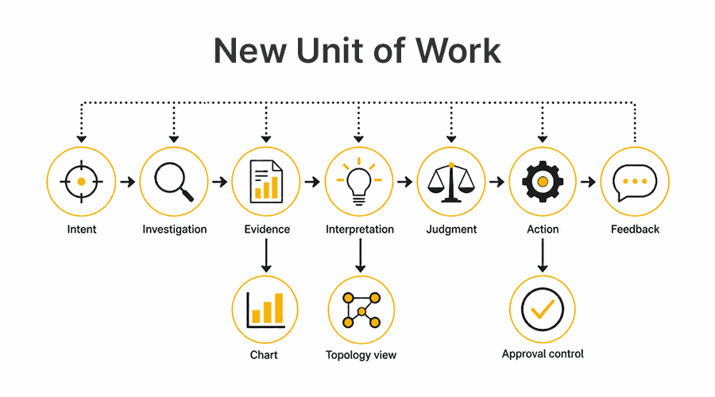
That loop may branch. It may return to an earlier assumption. It may involve several people or specialist agents. It may generate a chart for one step, a topology view for the next, and an approval control when action is required.
The interface becomes fluid because the situation is fluid.
This does not mean traditional applications disappear. Systems of record, databases, dashboards, APIs, workflow engines, and deterministic controls remain essential. They become the infrastructure and tools the agent uses.
But the human no longer has to coordinate every system manually.
Data is the Foundation
An intelligent model without enterprise context is only generally knowledgeable: it does not understand your customer, network, factory, product, or organization.
For an agent to participate in real sensemaking, it needs access to trusted data, organizational knowledge, tools, and history.
The model provides cognitive capability.
The data provides situational awareness.
The tools provide the ability to act.
Governance determines what the agent is allowed to do.
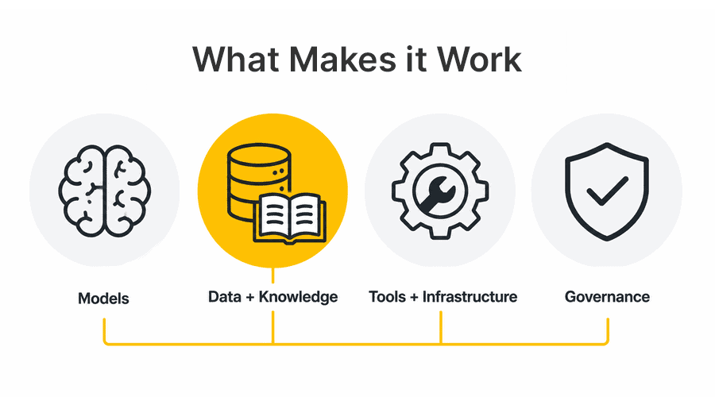
If the data is incomplete, disconnected, stale, or poorly defined, the agent may construct the wrong picture and offer a convincing explanation that does not match operational reality.
A trustworthy system should show the evidence behind its recommendations, surface uncertainty, and actively look for information that challenges its leading explanation.
AI-Augmented Sensemaking therefore makes data foundations more important, not less.
Beyond the Agentic Workflow
Enterprises have been moving through several stages of AI adoption.
First came isolated use cases: summarize this document, draft this message, answer this question.
Then AI entered workflows: classify the request, retrieve the data, prepare the response.
Now organizations are pursuing agents that can plan, select tools, and execute multi-step work.
AI-Augmented Sensemaking goes one step further.
Automation executes a known process. Agentic systems dynamically pursue a goal. AI-Augmented Sensemaking applies when the correct path cannot be known in advance.
The objective is not merely to automate a workflow. It is to determine what is happening, what matters, which path the situation requires, and what action should follow.
That is where much of the highest-value work occurs: incident resolution, strategy, product design, customer escalation, research, risk assessment, operational optimization, and executive decision-making.
These are not just processes waiting to be automated.
They are situations waiting to be understood.
The New Working Normal
Soon, interacting with agents will feel less like operating software and more like working with a capable team.
We will describe intent, explore evidence, challenge explanations, follow intuition, call in specialist capabilities, and act through the systems around us.
The agent will bring speed, memory, synthesis, tools, data access, and specialized expertise.
The human will bring purpose, context, intuition, values, judgment, and accountability.
Applications will still be there. But increasingly, they will sit behind the conversation, supplying the data and capabilities required in the moment.
The future of work is not simply humans using better applications.
It is humans and agents making sense of situations together – and then, when authorized, doing something about them.