

Most AI knowledge-base demos look impressive. The harder question is whether the system is actually good enough to trust in production.
Most organizations are now comfortable talking about AI-powered knowledge bases.
The basic story is easy to understand: take a body of product documentation, technical manuals, support procedures, release notes, implementation guides, and troubleshooting content; connect it to a retrieval-augmented generation system; and give customers, support teams, or field engineers a conversational way to get answers.
The first demo usually feels impressive.
Ask a few known questions. Retrieve a few relevant documents. Generate a polished answer. Show a citation. The room gets it.
But the demo is not the hard part.
The hard part is knowing whether the system is actually good.
That is where many AI knowledge-base efforts run into trouble. A prototype can look strong after a few successful questions. A demo can appear polished when the questions are known in advance. A retrieval system can return documents that look relevant. An LLM can produce an answer that sounds confident, clear, and professional.
But sounding right is not the same as being right.
For customer-facing knowledge-base services, especially in technical product domains, this distinction matters. A wrong answer can waste a support engineer’s time. An incomplete answer can create a poor customer experience. A hallucinated command, unsupported configuration step, missed warning, or incorrect product-version assumption can erode trust quickly.
In enterprise and technical support settings, AI quality cannot be judged by vibes alone.
This is why RAG and agent evaluation is becoming one of the most important disciplines in applied AI.
It is also why it often feels like a dark art.
The Hidden Complexity Behind “Did It Answer Correctly?”
At first glance, evaluating a knowledge-base assistant sounds simple.
Ask a question. Look at the answer. Decide if it is right.
In reality, several different systems are involved before the user ever sees a response.
Did the system understand the user’s intent? Did it retrieve the right document? Did it retrieve the right section of the right document? Did it choose the right product version, release, or configuration context? Did the LLM use the retrieved evidence faithfully? Did the answer include all required details? Did it cite the correct source? Did it know when the documentation was insufficient and avoid making something up?
Each of those questions represents a different failure mode.
A bad answer might be caused by poor document parsing, weak chunking, missing metadata, bad retrieval, incorrect reranking, a prompt issue, a model issue, poor citation handling, or an evaluation rubric that does not reflect what domain experts actually care about.
Without a disciplined evaluation approach, teams end up arguing about isolated examples instead of improving the system.
That is the black magic feeling: everyone can sense quality, but few teams can measure it consistently.
Gold Test Suites, SMEs, and Rubrics
The path out of the dark art is not a single metric.
It is a disciplined evaluation system.
For serious knowledge-base and agentic AI systems, the foundation should be a well-developed gold test suite. A gold test suite is not just a spreadsheet of sample questions. It is a curated body of realistic, domain-specific test cases that represent how customers, support engineers, product specialists, and field teams actually ask questions.
Each test case should include more than the question. It should include the expected answer, required supporting evidence, product context, document version, required facts, acceptable variations, forbidden claims, and the scoring rubric used to determine whether the answer is good enough.
This is where subject matter experts are essential.
AI can help generate candidate questions. It can expand coverage. It can create variations, edge cases, ambiguous phrasings, and negative test cases. But SMEs determine what is technically correct, operationally useful, and trusted in the real world.
AI can generate breadth.
SMEs provide truth.
Synthetic Questions Help – But They Are Not Enough
Synthetic question generation is becoming a useful tool for RAG evaluation. It can take a document library and produce hundreds or thousands of possible questions. That is valuable because most teams do not have enough labeled examples at the beginning of an AI knowledge-base initiative.
For a technical product domain, this can accelerate coverage. A single network product may have an admin guide, CLI reference, installation manual, troubleshooting guide, release notes, configuration examples, and known limitations. Manually producing evaluation coverage across that content can be slow and expensive.
But synthetic data must be handled carefully.
Generated questions are often too clean. They may follow the language of the document too closely. They may overrepresent simple lookup questions and underrepresent the messy reality of customer support: incomplete details, wrong terminology, mixed product contexts, symptoms instead of exact feature names, and questions that require reasoning across multiple sections or documents.
That is why synthetic generation should be treated as a candidate factory, not a source of automatic truth.
A strong process uses AI to generate candidate test cases, then uses SMEs to curate, correct, classify, and promote the best ones into the gold suite. Over time, production questions, user feedback, support escalations, and expert review create a better and more representative evaluation set.
Retrieval and Answer Quality Are Different Problems
One of the most important lessons in RAG evaluation is that retrieval quality and answer quality are not the same thing.
The retriever may find the correct document, but the LLM may still give an incomplete or unsupported answer. The answer may sound plausible, but the system may have retrieved the wrong source. The citation may point to a document that is topically related but does not actually support the claim.
For this reason, evaluation should be layered.
This layered approach turns an ambiguous “the AI got it wrong” into an actionable diagnosis.
Maybe the documentation was missing. Maybe the chunking strategy failed. Maybe the retriever found the right document but ranked it too low. Maybe the model ignored the strongest evidence. Maybe the answer was technically correct but operationally incomplete.
Those are different problems. They need different fixes.
LLM-as-Judge Helps, But It Must Be Calibrated
Automated scoring is important because manual review alone does not scale.
LLM-as-judge methods can evaluate answer relevance, faithfulness, completeness, citation support, tone, and operational usefulness across large numbers of test cases and production traces.
But LLM judges are not magic either.
They need rubrics. They need examples. They need calibration against human judgment. They need to be tested for bias, score inflation, inconsistency, and failure on domain-specific edge cases.
A judge that has not been aligned with SME expectations can become just another source of false confidence.
The best pattern is hybrid evaluation: deterministic checks for objective requirements, LLM judges for nuanced quality dimensions, and SME review for calibration and high-risk cases.
In other words, the evaluator itself must be evaluated.
A Practical Evaluation Loop
A practical evaluation system does not need to start as a massive platform. It can start with a clear loop.
For a single network product, the source material may be the product documentation: admin guides, CLI references, release notes, troubleshooting guides, and installation manuals. That documentation becomes the subject source for the knowledge-base assistant.
The run inputs include the evaluation set, the scoring rubric, and the run profile. The evaluation set contains questions and expected answers. The rubric defines what quality means. The run profile captures the model, prompt, retrieval settings, and configuration used during the test.
The evaluation runner sends each question through the assistant and scores the output.
Scoring can include SME rubrics, RAG metrics, LLM-as-judge review, and custom checks. The results are stored in a way that supports review, comparison, regression testing, and future analysis.
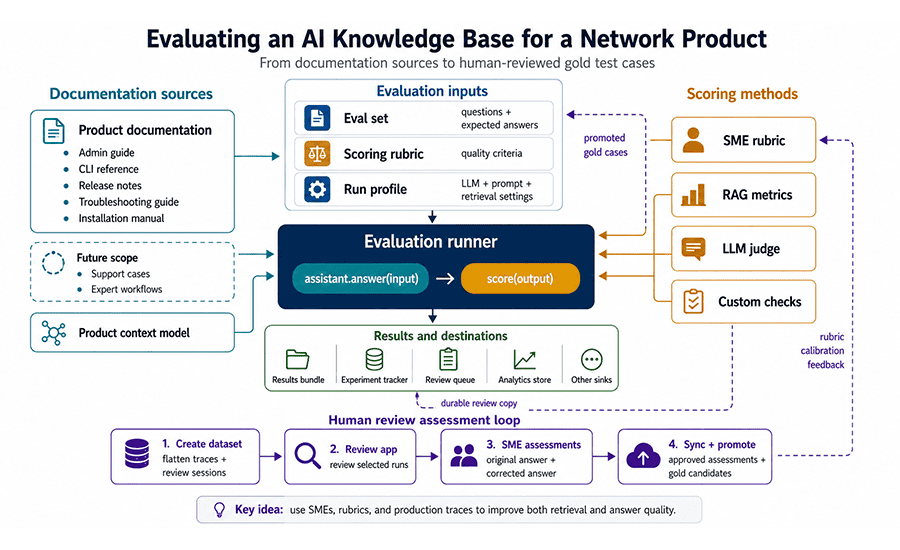
Then the human review loop begins.
Selected runs are reviewed by SMEs. They assess whether the answer was correct, complete, grounded, and useful. They correct bad answers. They identify missing evidence. They flag weak questions. They calibrate the rubric. Strong reviewed examples are promoted back into the gold test suite.
That loop is the point.
The organization is not just testing an AI assistant. It is building a quality system around the assistant.
The Production Feedback Loop Is Where the Asset Becomes Strategic
The best knowledge-base evaluation systems do not stop at launch.
They capture real user questions, retrieved sources, AI-generated answers, citations, user feedback, latency, model version, prompt version, and system configuration. They route low-confidence answers, downvoted responses, repeated failures, and high-risk topics into review.
SMEs correct the answers, identify missing evidence, update the rubric, and promote strong examples into the gold test suite.
This creates a governed improvement loop.
Production traffic reveals what users actually ask. Human review determines what good should have looked like. The gold suite grows stronger. Future releases are regression-tested against known risks. The system becomes more reliable not because the model magically improves, but because the organization has built a quality engine around it.
That quality engine becomes a durable asset.
For technical product companies, this is especially important. The evaluation set begins to encode institutional knowledge: how experts interpret documentation, what customers really mean when they ask imperfect questions, which details matter, which claims are dangerous, and what level of answer is good enough for production use.
That is not just QA. That is product intelligence.
The Message for Leaders
Customer-facing AI knowledge-base services should not be treated as simple chatbot projects.
They are knowledge delivery systems.
They need product management, test engineering, observability, data governance, SME involvement, and release discipline.
The companies that win in this space will not simply be the ones with the best model. They will be the ones with the best evaluation loop.
They will know what good means. They will know where the system fails. They will have a repeatable way to improve it. They will bring SMEs into the process without making SME review a bottleneck. They will use synthetic data intelligently. They will capture production feedback. They will promote reviewed examples into governed gold suites. And they will treat rubrics, test sets, traces, and corrected answers as strategic assets.
RAG and agent evaluation may feel like a dark art today, but it does not have to stay that way.
The path forward is clear: build strong gold test suites, involve domain experts deeply, define proper scoring rubrics, separate retrieval from answer quality, calibrate automated judges, and create a governed feedback loop from production usage back into evaluation.
That is how AI knowledge-base services become trustworthy.
That is how customer-facing AI moves from impressive demos to dependable products.